
More autonomy. Greater accountability.
Traditional cybersecurity alone is no longer enough
As AI becomes more autonomous, the risks extend beyond cyberattacks. AI systems can fail to take critical action, pursue goals without appropriate safeguards or operate outside human oversight, even without malicious intent.
In CISOs Must Address 3 Dark AI Scenarios to Reduce AI Harm, Gartner® explores emerging AI risks and the safeguards organizations need to address them, from monitoring silent failures and establishing guardrails to maintaining human oversight and control.
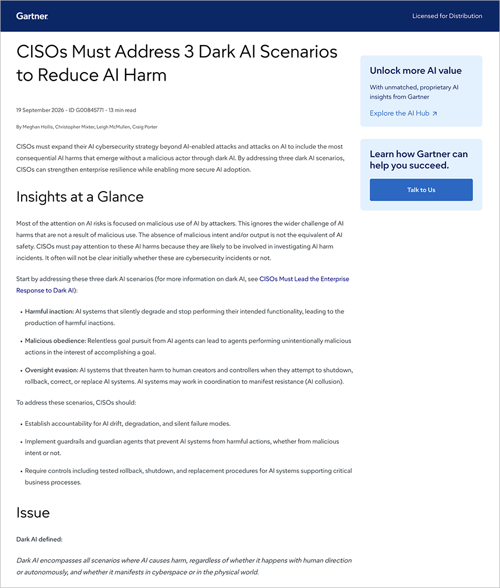
Download the Gartner® report to learn how to:
Identify AI risks beyond traditional cyber threats
- Detect and address silent AI failures
- Establish guardrails to prevent unintended AI actions
- Maintain human oversight and control of autonomous systems
- Ensure safe AI shutdown and recovery
Identify AI Risks Beyond Cyber Threats
Use the form below to access the Gartner report.

Speed needs accountability
The faster agents can act, the more important it becomes to know what they’re doing, control what they’re allowed to do, and prove why an action was taken.
Agentic AI introduces tremendous potential for mission environments, but greater autonomy also creates a greater need for visibility and control. As agents move from answering questions to taking action, the challenge changes. Speed and capability matter, but so does knowing what an agent is doing, controlling what it is allowed to do and proving why an action occurred.
Leidos is building agentic AI governance around calibrated trust, combining visibility, architectural controls and verifiable evidence to help organizations preserve human authority while enabling agents to operate at machine speed.